How to audit your FPL team before the deadline
A ten-minute pre-deadline checklist for Fantasy Premier League managers, from injury flags and bench order to whether a points hit is really worth it.
Fourth Officials team
4 min read
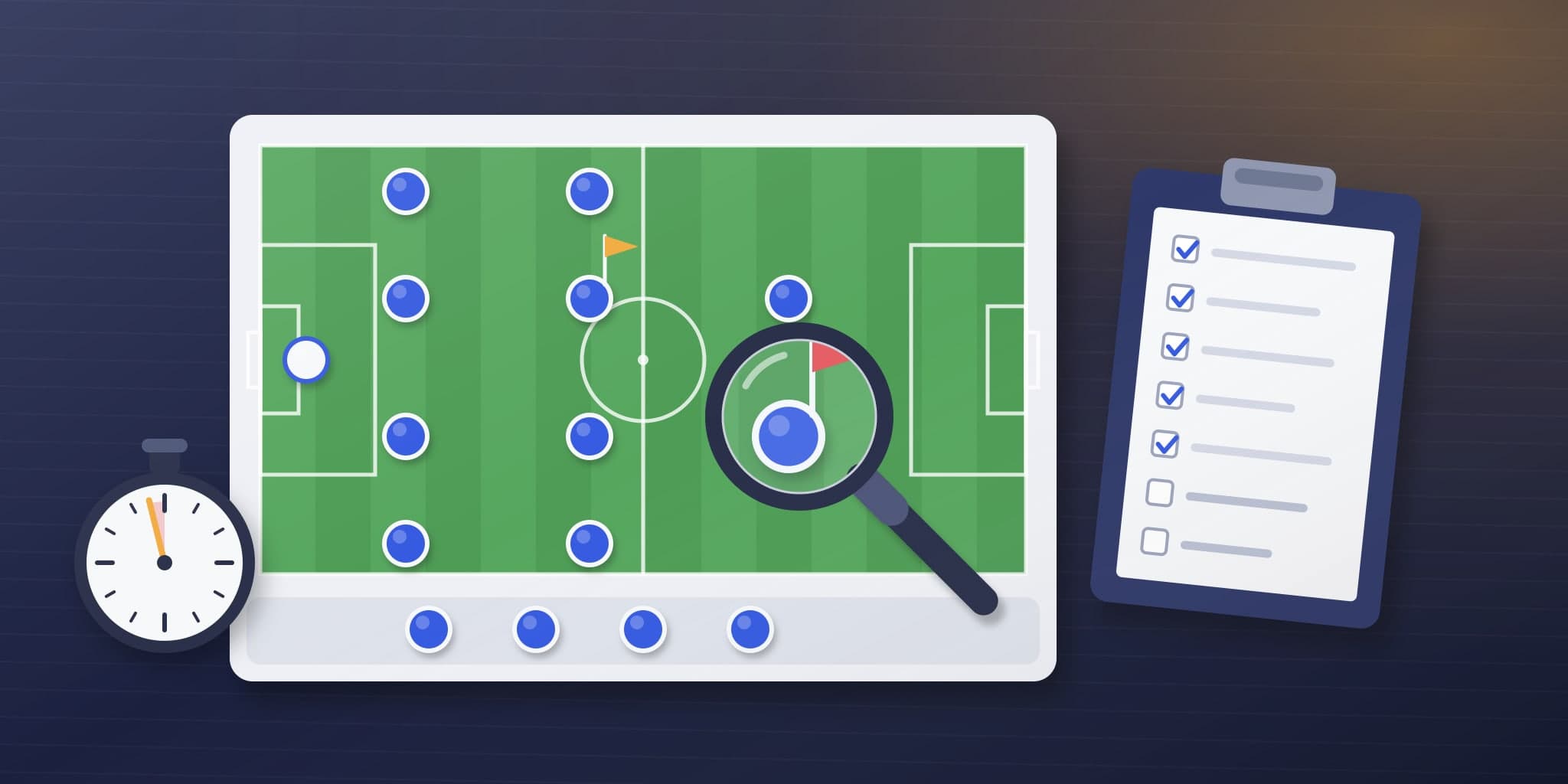
Most Fantasy Premier League points are lost in the hour before the deadline, not on the pitch. A player you forgot was flagged starts on your bench. A transfer you were sure about costs four points and returns two. The armband goes to a name, not a number.
None of this needs hours of research. It needs a routine. Here is the one we use, in the order that catches the most expensive mistakes first.
1. Check availability before anything else
Open your squad and look for every flag: injuries, illness, suspensions, and players listed with a reduced chance of playing. Read the news line, not just the colour. "Knock, 75%" and "Hamstring, unknown return date" are very different problems.
Then check the less obvious risks:
- Rotation. A fit player who is likely to be benched because of a midweek cup or European tie.
- New signings and returning players. Often eased in with 20 or 30 minutes.
- Suspension risk. A player one booking away from a ban may be managed by his club.
A player who doesn't play scores zero for you unless an auto-sub covers him, and that depends on your bench, which is step 3.
2. Pick your starting XI by expected points, not reputation
Once you know who is available, pick the eleven players most likely to score the most points this gameweek. That sounds obvious. In practice most managers start the same eleven every week and only change it when someone is injured.
Ask of each borderline pick:
- How likely is he to play 60 minutes or more?
- How good is the fixture, for both his attack and his defence?
- Does he have a role that earns extra points, such as penalties, set pieces, or defensive work that counts towards defensive contribution points?
3. Order your bench on purpose
If a starter plays no minutes, FPL substitutes in the first eligible player from your bench, in bench order, as long as the swap keeps a valid formation. Your goalkeeper is only replaced by your backup goalkeeper.
So the bench order is a decision, not an afterthought:
- Put the outfield player most likely to play and score first.
- Put players who are doubtful, or who face a hard fixture, last.
- If you start a doubtful player, make sure a reliable sub sits directly behind him in a position that keeps your formation legal.
4. Choose a captain with the biggest gap, not the biggest name
Your captain's points are doubled, so the armband is usually the single largest decision of the week. The right question is not "who is the best player?" but "who is most likely to outscore everyone else in my team this gameweek?"
We wrote a whole guide to this: captaincy picks using expected points. The short version is to weigh minutes, fixture and role together, and to set a vice-captain who will actually play.
5. Look two or three gameweeks ahead
A player with one great fixture followed by three hard ones is a weaker hold than a player with a steady run. Before you transfer anyone in, look at his next few fixtures, not just this weekend's. The same applies to selling: a player in a short dip with a good run coming may be worth keeping.
6. Only take a hit when the maths says so
Each transfer beyond your free ones costs four points. That cost is certain. The gain is a guess. A hit pays off only when the incoming player is expected to outscore the outgoing one by more than four points over the gameweeks you plan to keep him.
Some quick rules:
- A hit to replace a player who won't play is often worth it, because the outgoing player's expected points are close to zero.
- A hit to swap two fit, similar players for one good fixture rarely is.
- Unused free transfers roll over (up to a limit), so saving one is a real option, not a wasted week.
7. Check structure and budget
Look at where your money sits. A lot of value on the bench is value not earning points. Check that you still have the bank to make the move you are planning next week, and that you are not over the limit of three players from one club after a transfer.
8. Decide on chips deliberately
Wildcard, Free Hit, Bench Boost and Triple Captain are each worth most in specific situations: a squad that needs many changes, a gameweek where many of your players don't play, a strong bench in a good week, or a standout captain option. If none of those apply this week, the best chip decision is usually to keep it.
Let a tool do the arithmetic
Steps 2, 3, 4 and 6 are mostly arithmetic. They are tedious to do by hand for fifteen players, and that is exactly where pre-deadline mistakes come from.
That is why we built Fourth Officials. You import your team with its FPL entry ID and it grades your squad against our own expected-points model in seven areas: Starting XI, Captaincy, Bench, Fixture outlook, Structure & budget, Availability risk and Ownership profile. It also compares your chosen XI and captain with the best XI you could field from your own fifteen, and shows the expected points you would leave on the table. You still make the calls. It just makes sure you make them with the numbers in front of you.
Projections are estimates, not guarantees. Football is noisy, and no model can tell you what will happen on Saturday. A good routine means that when things go wrong, it is bad luck and not a mistake you could have caught.
Audit your own team before the deadline
Paste your FPL team ID. Fourth Officials grades it against our expected-points model and suggests lineup, captain, transfer and chip moves for the next gameweek.